Nearly 70% of first-time homebuyers are renters right before they buy, so if you're working with rental clients today, you're already sitting on tomorrow's buyer pipeline. Let's go over the signals that tell you a renter is ready, how to open the financing conversation without sounding pushy, and the misconceptions that keep qualified renters on the sidelines.
Renters Are Your Largest Untapped Buyer Pipeline
About a third of U.S. households rent, and in urban and suburban markets that number climbs to 40 to 50%+. If your business is built on helping people find a home then this is the market to know cold.
113M
renters in the U.S., the largest untapped buyer pool in real estate
~70%
of first-time buyers come from rentals
2 out of 3
renters plan to buy in the future
Roughly 70% of first-time buyers are transitioning out of a rental, making this market the single largest pipeline for buyer business, whether or not you're actively thinking of it that way.
With Fannie Mae's research showing 2 out of 3 renters plan to buy, most within a 1 to 5 year window, the desire to buy hasn't gone anywhere.
What's Changing Right Now
The pool of renters ready to buy shifts with the market. Here are a few forces moving in buyers' favor:
Mortgage rates: NAR estimates 1.6 million more renters qualify to buy at a 6% rate
For-sale supply sits around 4 to 5 months nationally, giving buyers more choice
$3.2B in down payment assistance funding for 2026, up 14% from 2025, with income limits rising in many states
First-time buyer tax incentives are gaining traction in multiple states
Monthly mortgage payments dropped below 30% of household income for the first time since 2022
Sellers are offering concessions that reduce upfront buyer costs
Buy vs. Rent, By the Numbers (Q2 2026)
The gap between renting and buying has closed in some markets and even flipped in favor of buying in others. Here's how it breaks down:
Market
Monthly Purchase Cost
Buy vs Rent Monthly Premium
North Carolina
$1,863
+$173 (but 12,000+ active rentals already exceed this)
Atlanta MSA
$2,596
+$801
Dallas-Fort Worth MSA
$2,945
+$845
Miami MSA
$3,092
−$39
Ohio
$1,763
−$803
Florida
$2,812
−$110
Texas
$1,892
+$4
National median premium: $686/month. Assumes 6.2% rate, 20% down, 30-year fixed. Source: Q2 2026 Rental Beast National Market Report; state data provided by Leader Bank.
In Ohio and Florida, buying is already cheaper than renting most months. In North Carolina, the median purchase payment sits below what 12,000+ active rentals currently charge, meaning plenty of renters there are already paying more than a mortgage would cost. Worth pulling up your own market's numbers before your next renter conversation.
Buyer Readiness Signals Every Agent Should Know
The typical first-time buyer is 40, though Leader Bank's own data on renters transitioning to homeownership puts the median at 43, with a range of 34 to 54. Gen Z, when surveyed, said they expect to buy around 30, so don't wait for someone to fit a stereotype before asking.
Leader Bank's data on renters who became buyers (January 2025 to April 2026) also shows:
25% average down payment (above the norm, often from savings plus other sources)
6 years renting before purchase
6 years at the same job, signaling income stability
Life-stage signals to watch for:
Marriage, a growing family, or a new job (major life changes that trigger the ownership conversation)
Wanting more control over the space (pets, renovations, paint colors)
Rent fatigue (rising costs, annual lease uncertainty, competition for units)
A stated desire for financial security or equity building
The Down Payment Myth That's Costing You Buyers
68.5% of renters believe getting a mortgage would be difficult. Most of them are wrong, and the biggest misconception is the 20% down payment myth.
~10%
median down payment, not the 20% myth
Here's how buyers actually fund it:
Savings59%
Financial assets26%
Gifts or loans22%
Loan programs widen the door further:
Conventional loans: as little as 3 to 5% down, with PMI required under 20% down
FHA loans: 3.5% down, with more flexible credit guidelines
VA loans: 0% down for eligible veterans and active military, no PMI
Jumbo loans: for anything above $832,750, sometimes at better rates than conforming loans right now
Beyond the loan itself, over 2,500 down payment assistance programs exist nationwide, and 12 states launched new programs in January 2026 alone. Co-borrowers, gifts, and grants can all fill the gap too.
Common Objections, and How to Answer Them
Objection
"Rates are too high."
Your Answer
Every 1/8% in rate is roughly $30/month on a $400K mortgage. Rates averaged around 4.5% in 2018; sub-3% was the anomaly, not the norm. If rates drop later, competition and multiple offers come back with them. Buying now means locking in today's negotiating power, and refinancing later is always an option. You can't go back and buy at today's price.
Objection
"I don't have enough for a down payment."
Your Answer
Many programs require just 3 to 5% down. A debt payoff strategy can also lower DTI, and paying off any debt with fewer than 10 months remaining removes it from qualification math entirely.
Objection
"I'm self-employed, I probably can't qualify."
Your Answer
Self-employed borrowers qualify every day. Two years of tax returns or bank statements often replace a W-2, and consistent income history matters more than employment type. 1099 and freelance income count too. Don't let a client self-disqualify before they've even talked to a lender.
Mistakes That Can Derail a Deal
Once a client is pre-qualified, a few common missteps can undo it before closing:
New debt — a new car loan or credit card between pre-qual and closing
Large money transfers — these raise flags for underwriters if the lender isn't looped in first
Job changes — fine if it's the same field, but should be disclosed
Underestimating taxes and insurance — these get folded into escrow and often surprise buyers
Rate fixation — locking in too early or chasing a number that may never come
How to Start the Financing Conversation
A three-step playbook:
1
Spot the Signal
Rent fatigue, questions about schools or neighborhoods, or talk of "settling down" are your cue.
2
Start the Conversation
Ask directly: "Have you ever thought about buying?" Then introduce a loan officer for a free, no-pressure pre-qual.
3
Move to Pre-Approval
Once the LO confirms eligibility, set a home search timeline. Pre-approval shifts a client from thinking about it to actively in market.
Pre-qualification and pre-approval are free to your client, and they cost you nothing. A pre-approval means income, assets, and credit have been verified through automated underwriting, which puts your client in a stronger position the moment they're ready to make an offer.
Five Things to Do This Week
Text three past rental clients: "Have you thought about buying?"
Check whether a client's current rent equals a purchase payment in your market
Stop pre-qualifying renters in your head. Ask.
Listen for triggers (new job, lease renewal, growing family) and follow up within 48 hours
Connect with a lender partner if you don't already have one you trust
Ready to Turn Your Rental Clients Into Buyers?
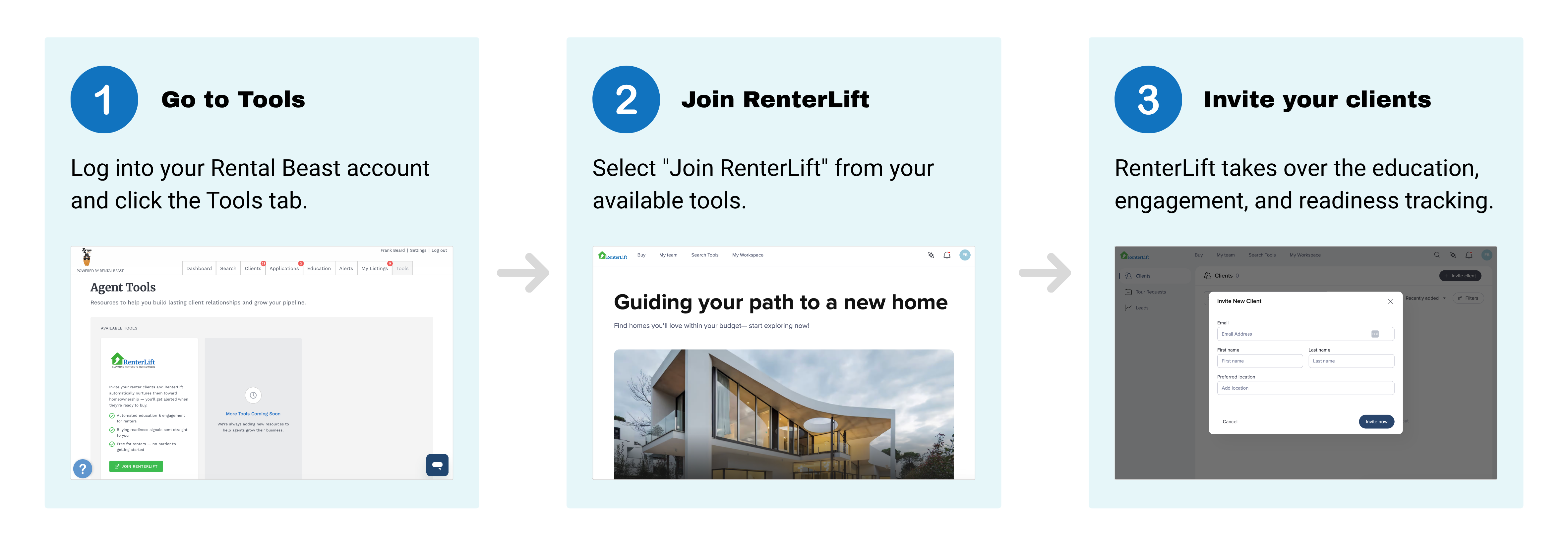
This is also where RenterLift comes in. As an AI-driven renter-to-buyer incubation platform, RenterLift is built to turn rental leads into qualified, financially prepared buyer leads, automatically. Once a client is invited, the platform takes over the long-term nurture work that agents don't have time to do manually:
Buying Power Calculator: giving renters a real, personalized read on affordability, estimated price range, and monthly payments
For-Sale Property Search: keeping renters visualizing their future purchase instead of drifting away after move-in
Homebuyer Education: automated, step-by-step nudges on saving, credit, and the buying process
Direct Expert Connections: so renters can reach out to their agent or loan officer inside the platform when they're ready
Automated Readiness Signals: so agents get notified when a client's behavior or financial profile signals real buying intent
Renters get a free, no-pressure roadmap, while agents get a pipeline that nurtures itself and tells them exactly when to re-engage.
You don't need to change how you run your business to benefit from RenterLift. There's no extra follow-up, no new workflow to learn, and no cost to enroll clients. Here's all it takes:
Your clients stay your clients, RenterLift doesn't sell leads to other agents, and you'll be notified as soon as real buying signals show up.
At the moment, RenterLift is available to members of Miami REALTORS®, MLS PIN, MLS United, and Doorify. Real estate professionals who are interested in RenterLift can sign up for the waitlist to stay up to date on when it's available in their market.
Ready to Put This Into Action?
🎥
Watch the Webinar
Get the full strategy breakdown from Josh Tayloe and Thom Croy.