The Q4 2025 rental market marks a turning point. After years of volatility, conditions have stabilized, but that stability comes with new pressures for property managers. Rent growth has slowed, renter behavior has normalized, and leasing has become more competitive.
Rental Beast’s Q4 2025 Rental Market Report combines national rental data with direct sentiment from property managers across major U.S. markets, offering a clear picture of how operators are adjusting as we head into 2026.
Property managers are largely aligned in their outlook for the near term:
This sentiment reflects a market that has found its footing but one that no longer supports aggressive rent growth. For property managers, this means performance in 2026 will depend less on pushing rents and more on execution, pricing discipline, and vacancy control.
Applicant flow tells a similar story:
Demand hasn’t disappeared, but renters are more selective. Listings that are priced right and marketed effectively are leasing. Others are sitting longer.
One of the clearest signals in the Q4 data is the rapid rise of concessions.
Nationally, the share of listings offering concessions climbed steadily throughout 2025:
That eight-point jump in Q4 alone underscores a key shift: concessions are becoming a standard tool in leasing.
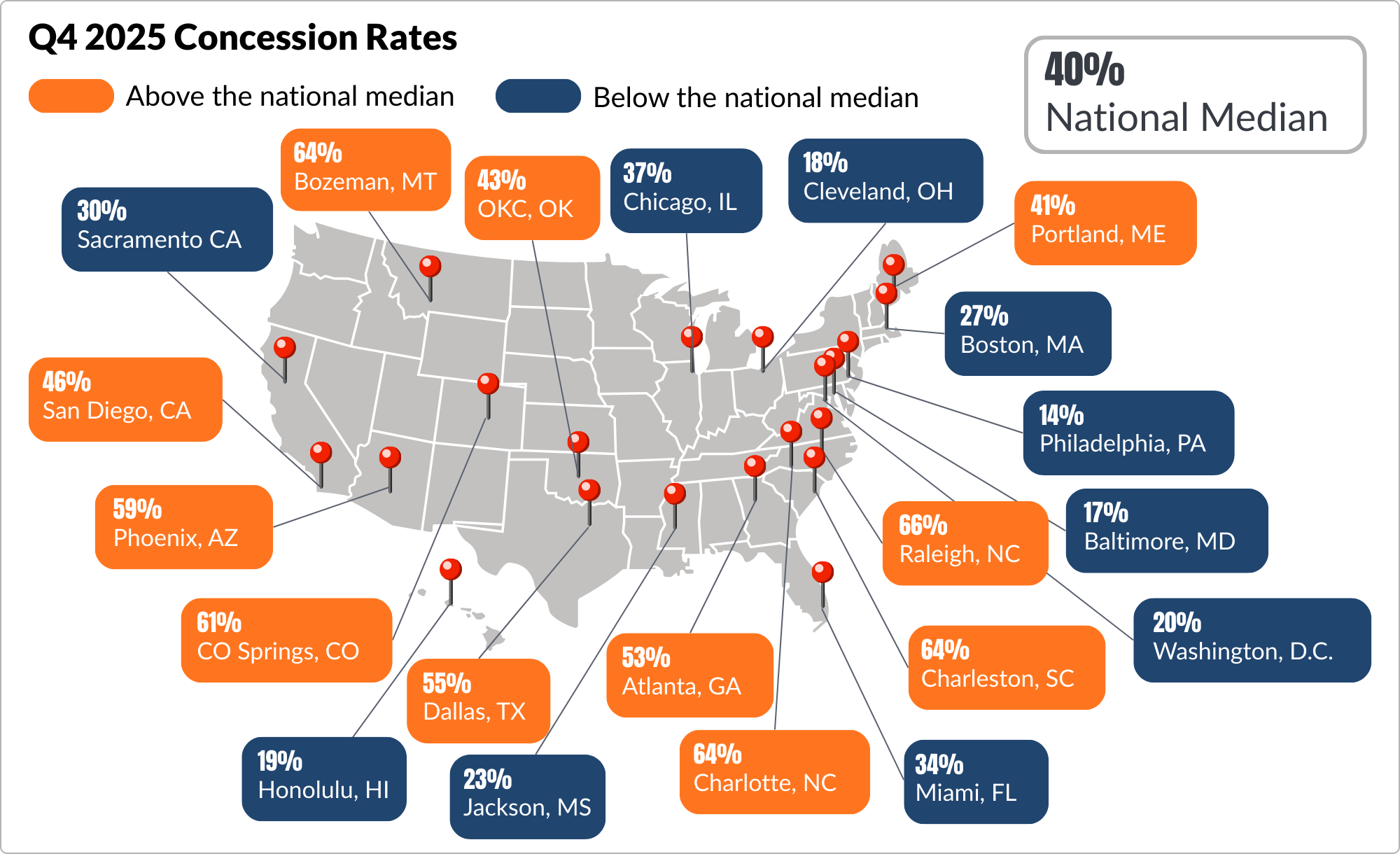
While concessions are rising everywhere, the intensity varies dramatically by market.
High-concession markets in Q4 2025 include:
In these MSAs, incentives are now part of the baseline competitive landscape. Properties without concessions risk longer vacancies, even if asking rents appear “market rate.”
Meanwhile, other markets remain more restrained:
These markets benefit from steadier demand, but even here, concessions have become more targeted
Importantly, rising concessions don’t signal a collapse in demand. Instead, they reflect how property managers are adapting to a market where:
Rather than cutting rents immediately, many owners are choosing to preserve face rent while using incentives to close deals. In practice, this shifts the focus from asking for rent to effective rent and places greater responsibility on property managers to explain trade-offs clearly.
For property managers, this environment rewards those who:
Q4 2025 was about resetting expectations. Property managers are operating in a market that is balanced, competitive, and far less forgiving of mispricing or slow adjustments.
The operators who perform best in this environment will be those who treat concessions as a managed tool and who rely on data to guide pricing, timing, and owner communication.
Read the full Q4 2025 Rental Market Report for a deeper dive into rent trends, concessions, days on market, and property manager sentiment across 17 U.S. MSAs.


