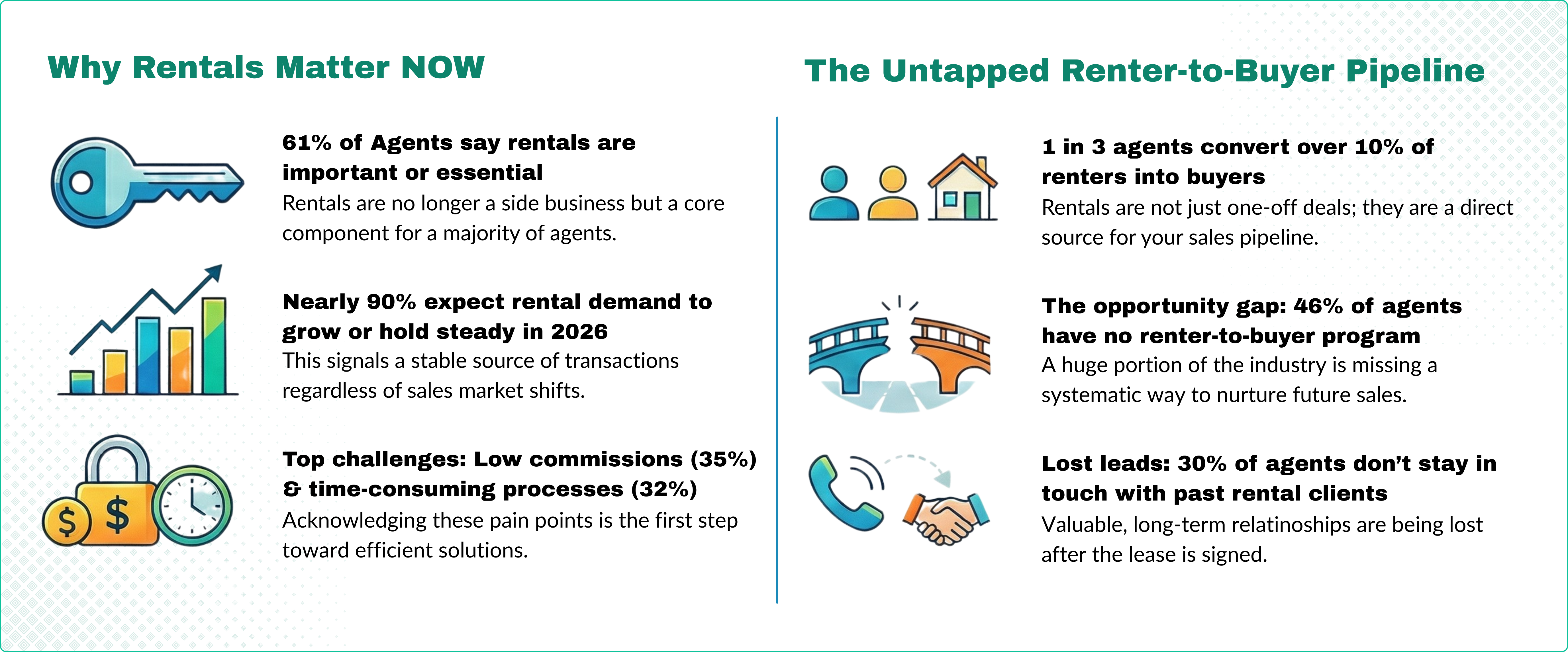
For decades, the real estate industry has been defined by the ‘For Sale’ sign. But a fundamental shift is underway, moving rentals from the periphery to the core of a modern agent's strategy. A new survey of over 300 agents reveals a telling statistic: over 61% now consider rentals either "essential" (42%) or "important" (19.5%) to their overall business. The survey was conducted in 2025, with findings reflecting agent sentiment and expectations heading into 2026.
This data signals that rentals are no longer a side business or a necessary inconvenience; they are a core pillar for growth and stability. These findings are part of a broader set of insights explored in Rental Beast’s 2026 Annual Agent Report, which takes a deeper look at how agents are adapting their businesses, where rentals fit into long-term strategy, where inefficiencies persist, and where future opportunity is being lost or unlocked.
The majority of agents are already deeply involved in the rental market, with 42% of agents counting rentals among their primary business activities, alongside sales. This isn't a temporary trend but a foundational component of their current operations.
Looking ahead, this reliance on rentals is set to become even more critical for business stability and growth. Agents anticipate strong and steady demand in the coming year, reinforcing rentals as a reliable income stream.
With nearly 90% of agents anticipating steady or growing demand, the rental market represents a reliable source of transactions that can insulate a business from the fluctuations of the sales market.
Beyond the immediate transaction, rentals offer an immense, yet often untapped, opportunity: a direct pipeline to future homebuyers. The survey shows that one in three agents (34%) convert 10% or more of their renters into homebuyers, proving that a rental lease can be the start of a long-term, high-value client relationship.
Despite this clear potential, a significant portion of future sales revenue is being lost due to a lack of systematic follow-up. The data reveals a major gap between the opportunity rentals present and the processes agents have in place to capture that value.
This lack of strategy represents a significant loss of long-term value from deals agents have already closed, effectively leaving future commissions on the table.
Agents identify two primary challenges with rental transactions: Low commission value (35%) and the Time-consuming process (32%). A major driver of this inefficiency is severe market fragmentation. Agents are forced to juggle multiple, disconnected platforms to find both listings and leads, draining valuable time that could be spent closing deals.
This fragmentation is evident in where agents source their inventory and clients:
This data reveals a critical operational gap: while the MLS is the top source for inventory, it is the least-used of the top three channels for finding the renters to fill that inventory, forcing agents to constantly switch between platforms and manual networks.
When facing these challenges, agents are clear about what they need. Trust, particularly in the MLS, is the single most important factor driving their adoption of new tools.
Beyond trust, agents prioritize efficiency and a seamless user experience for both themselves and their clients. Their ideal solution must be fast, simple, and intuitive.
Top Priorities for Rental Tools:
The message is clear: agents need a trusted, MLS-backed solution that is simple, fast, and integrated directly into their existing workflow to make rentals a profitable part of their business.
The survey data points to a clear conclusion: rentals are no longer a side hustle, but the systems supporting them haven’t caught up. Agents are operating in a fragmented environment: separate tools for listings, leads, applications, screening, and follow-up, while simultaneously expecting rentals to deliver stability, efficiency, and long-term value.
What agents are asking for alignment: trusted tools, faster workflows, and simpler experiences that fit naturally into how they already work. MLS-backed solutions, integrated processes, and renter-friendly experiences consistently rise to the top as priorities, underscoring the importance of trust and efficiency in rental transactions.
Just as importantly, the data highlights a mindset shift that still needs to happen. Rentals aren’t just transactions to get through quickly; they are relationships that, when managed intentionally, can mature into future sales opportunities. The gap between agents who successfully convert renters into buyers and those who lose touch entirely isn’t market-driven—it’s process-driven.
As the sales market continues to ebb and flow, the agents best positioned for long-term success will be those who treat rentals as a strategic business line, not an operational burden. The opportunity is already there. The next step is building the workflows, habits, and systems that allow rentals to deliver on their full potential.


